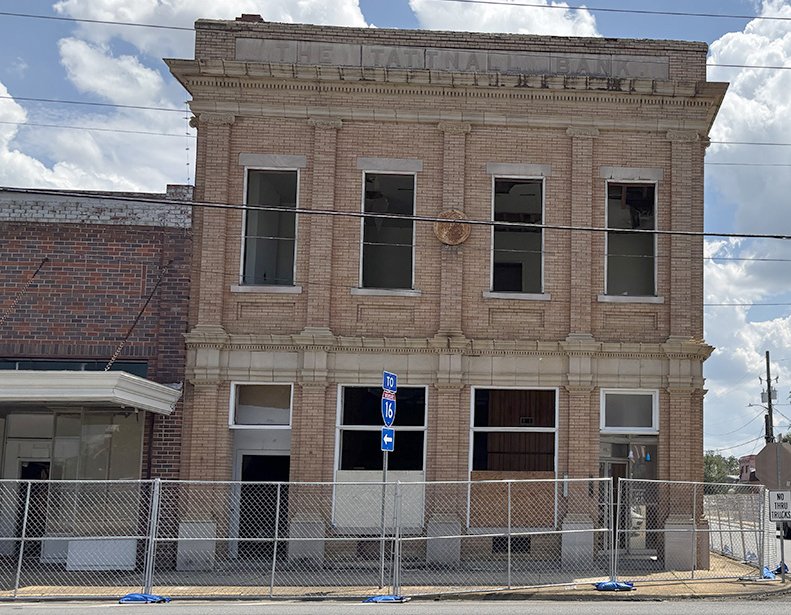
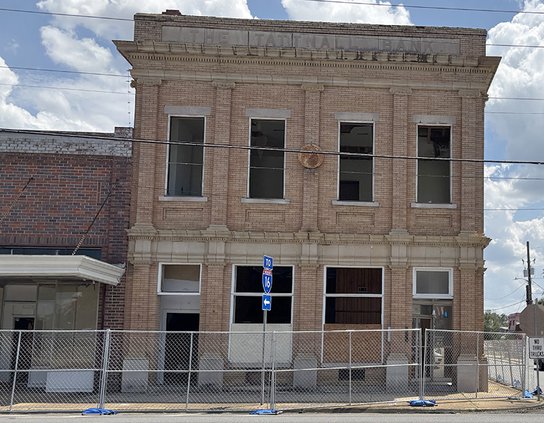
The Tattnall Bank, which was the cornerstone for economic development in Reidsville and Tattnall County for more than a century, opened for business on October 22, 1900, in the building on Church Street where the old City Barbershop would operate from the 1940s until the early 1980s. In 1901, the bank moved into the new, imposing structure on the corner of Brazell and Church Streets. Fittingly, it was directly across Brazell Street from the new (fifth) Tattnall County Courthouse that was constructed in 1903.
The initial officers were: C.W. Brazell, President; Caleb W. Smith, Vice President; and Ben H. Groover, Cashier. Directors were F.M. Alexander, C.W. Brazell. J.V. Kelley. W.M. Rogers, and C.W. Smith. Presidents of the bank from 1900 to 2009 were C.W. Brazell; C.W. Smith; J.V. Kelley; W.E. Smith, Jr.; J.C. Kennedy, Sr.; Ralph Huckabee; E.B. Register, Sr.; E.B. Register, Jr.; E.B. Register III; Glen A. Cheney; Mary T. Scott; and Johnny R. Myers.
The 1901 Tattnall Bank building was a fitting symbol of the Tattnall County seat, along with the new Courthouse in 1903. At the time, Tattnall County was about 34 miles wide and 35 miles long, and those two magnificent buildings provided a visual image of the optimism of the Tattnall County business leaders and citizens at the turn of the century. At that time, the County covered an area of about 1100 square miles.
However, residents on the outer fringes of the county complained about the distance they had to travel during the horse and buggy days to the county seat for official visits, including court sessions, and in 1905, Toombs County was organized out of the western section of Tattnall and Montgomery counties. About two-thirds of Toombs came from Tattnall. Then, in 1914, Candler County and Evans County were carved out of north Tattnall County. About one-third of Candler and about four-fifths of Evans came from Tattnall. This left Tattnall with a total area of about 500 square miles.
With those circumstances in mind, Reidsville and Tattnall County thrived mostly due to agriculture from 1900 to the present, and the new (fifth) Courthouse served as the political and administrative center of the new county, and the Tattnall Bank served as a financial leader in the local community.
The Tattnall Bank provided wartime financial services for local citizens during World War I (the Great War) and then helped farmers and local business weather the post war recession that lasted from January 1920 to July 1921. Farmers had to adjust from wartime production that included government support prices on commodities like wheat and corn. Wholesale prices dropped by 45 percent, and industrial production declined before an unassisted market economy returned in 1922.
In October 1929, the greatest financial crisis in the history of the United States and the world began with the collapse of the stock market on the New York Stock Exchange. Locally, the Tattnall Bank had to stay afloat financially while assisting the people of Reidsville and Tattnall County survive in a bleak economic landscape of spiraling deflation that led to an abrupt reduction of industrial production, a rapid loss of jobs, and reduced consumption. In short, people had no cash in which to purchase the most essential products for survival, which had an obvious devastating economic effect on local business and agriculture.
During the early days of the depression in the 1930s, Tattnall Bank President, J.V. Kelly helped persuade the State of Georgia to build the Georgia State Prison seven miles west of Reidsville on the west bank of the Ohoopee River. Mr. Kelly obtained options from the various landowners that helped many farmers avoid foreclosure and brought a badly needed payroll to the area.
In the mid-1930s, the Tattnall Bank supported the efforts of local citizens to bring a rural electric cooperative into Tattnall County. As a result, Canoochee Electric Membership Cooperative was formed in 1938, which provided an additional payroll in Tattnall County and provided electricity for homes and businesses that stimulated economic momentum to help the City of Reidsville and Tattnall County navigate through the dark days of the Great Depression.
Interestingly, as a direct result of the Great Depression, one of the longest serving employees, and certainly one of the most well-known and respected presidents of the Tattnall Bank, came to Reidsville from Homerville, Georgia. Elbert B. Register came to Reidsville in 1934 as a member of the 5410th Company of the Civilian Conservation Corps (CCC). He left the CCC in in 1936, and worked with the Washington Sales Company during that year. He worked briefly for the Georgia State Prison until 1939 when he joined the Tattnall Bank as a bookkeeper. He took jobs in the banking industry in Savannah, Tifton, and Claxton before becoming a Georgia Department of Banking and Finance bank examiner. He returned to the Tattnall Bank and became Executive Vice President, CEO, and Director in 1946, and then President and Chairman of the Board in 1973. He was active in the bank until his death in 2005. He was widely respected in the banking industry and was active in the Tattnall Bank for over 60 years.
For many, he became the face of the Tattnall Bank. Earl Boyett, a Marine Vietnam veteran moved to Reidsville in 1969 and opened an air conditioning business. He recalls working with Mr. Register on projects when he didn’t have enough cash on hand. He would call or visit and tell him that he needed a certain amount of money for 60 or 90 days to complete the projects, and Mr. Register would write down the amount and say, “The money will be in your account in the morning. Come by and sign the paperwork when you have time.” There would be a quick handshake, and Earl would go to work.
Once, when I was getting rich teaching U.S. History and coaching high school football at Reidsville High School, I needed a new truck and called and told him I needed some cash for a vehicle.
“Write a check for it, and come see me,” he said.
“What’s the interest rate?” I asked. “As much as I can get,” he chuckled. Then he added. “How does five percent sound.”
It was good. I knew GMAC (General Motors Acceptance Corporation) was offering loans at seven percent.
Those kinds of transactions could only be completed in a small-town bank where the parties involved knew and trusted each other. Certainly, Mr. Register did not conduct all business in that manner, but when he could, he did, and many transactions took place based on the traditional gentleman’s agreement. It was appreciated in a rural community, and it was one of many reasons the Bank prospered.
In 1951, a fire ravaged the bank building, and press reports of the terrible blaze indicated that only the brick walls were left undamaged, which was a tribute to the quality of the original masonry construction. Ramone Powell, a Tattnall County Sheriff’s deputy, stated that his father, the late Marvin Powell, who was 20 years old and a volunteer firefighter at the time, stayed up all night spraying water on the embers to keep the fire from reigniting. The volunteer fire department had one truck, and the hood had to be raised to keep the engine from overheating as the truck pumped water all night.
The bank was rebuilt, as would be expected, during that period. This was Immediately post-World War II, and the effects of the Great Depression lingered. If the bank could be reconstructed, it would be as it was the least expensive option. Revenues and expenditures had to be balanced, and there was not excess cash available for a new building.
In 1965, Tattnall Bank moved into the new building on the corner of Main Street and Brazell Street. The old building would continue to serve as the law office for Francis Stubbs and later as a real estate office. Along with the Tattnall County Courthouse, it remained a symbol of the heart and soul of the Reidsville and Tattnall County business and agricultural community during the 20th Century.
Sources:
A Brief History of the Tattnall Bank. Heritage Committee. The Tattnall County Heritage Book.
Tattnall County Established Early, Ceded Much Land to Other Sections. J.O. Alexander. The Tattnall County Heritage Book
Recession of 1920-1921, Randall Hannum. ebbsco.com/research-starters/history/recession 1920-1921
E.B. Register, Reidsville Banker. The Heritage Committee. The Tattnall County Heritage Book