By allowing ads to appear on this site, you support the local businesses who, in turn, support great journalism.
The changing face of smalltown USA

Downtown Demolition
Back of the buildings on Main Street

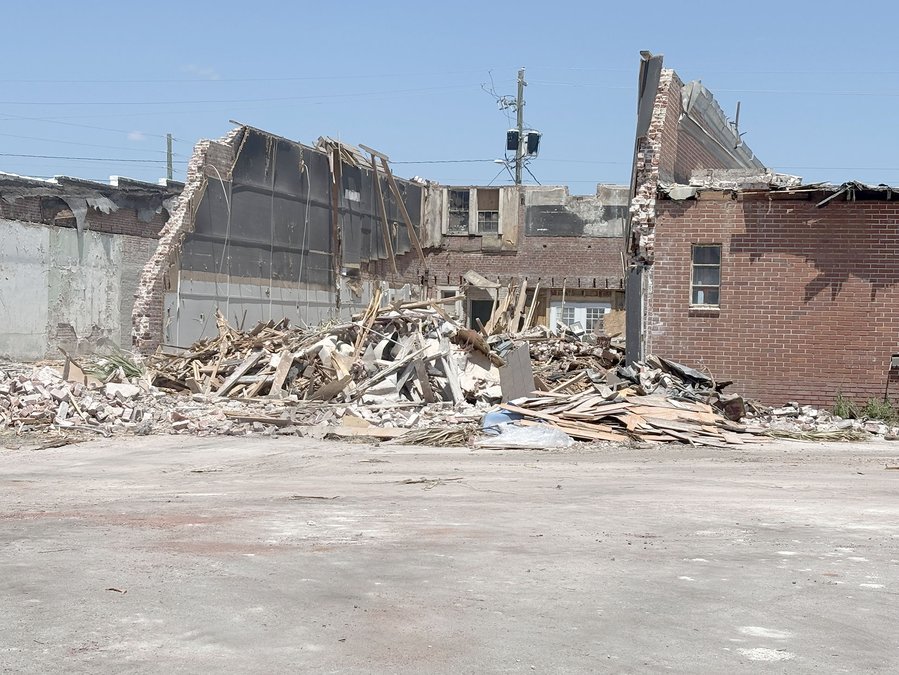
By the time this is published, the demolition of several historic buildings in the heart of downtown Reidsville will be complete or nearly so. For those who grew up in the 1950s through the early 1980s, it is painful to watch. We remember the vibrant Friday afternoons and Saturdays and those memorable people who made those days so enjoyable. In the late summer months, there was the unmistakable whiff of flue-cured tobacco on the clothing of tobacco farmers mixed with the distinct sweet aroma of boiled peanuts sold in ten cent bags by farm boys or, in some cases, by their parents. In those days, an afternoon’s sale of 250 dime bags earned much-needed cash in a time when cotton was handpicked for three cents a pound or $3.00 per 100 pounds.

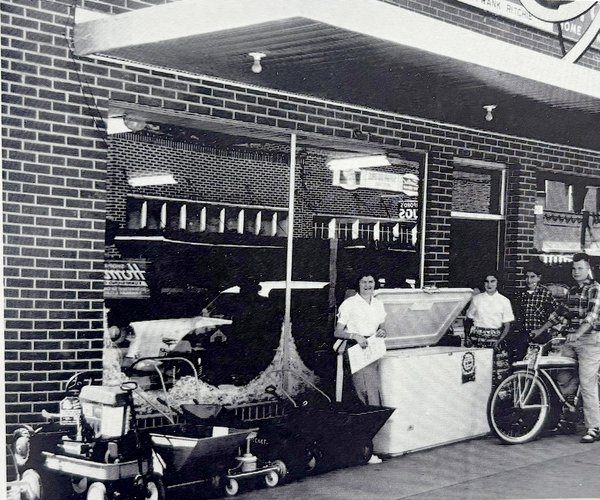
Friday afternoons and Saturdays were the most productive days for merchants as most farmers and families came to town on weekends to buy groceries, get a haircut, or conduct banking business. The business district along Main Street fairly hummed with activity, and friends often gathered in small groups to talk and get updated on events that may have occurred only a few miles away. Even on Saturday afternoons after dinner time (lunch these days), vehicle traffic was often so sparse that individuals and groups wandered across the streets everywhere. Jay walking was an unknown term; pedestrians had the right-of-way. Once when I was about five years old, a young man rode by my mother’s beauty shop on Main Street on a steer with oversized horns. It turned out to be E.B. Cowart, a neighbor who occasionally rode his steer about three miles to town. E.B. became an outstanding football player on the 1957 and ‘58 Reidsville High School foot ball teams and might have played for the University of Alabama but for a freak accident on horseback.

In the coming weeks, I will try to provide information about the businesses and recognize those who operated those establishments in the immediate area that is being demolished to create space for a new Circle K store. That business will provide gasoline, diesel, electricity for electrical vehicles, coffee, snacks, and food. In addition, I will try to recreate the post-World War II era of my youth and the sights, sounds and activities of what might be considered the heyday years for Reidsville and similar small towns throughout the South. The article will be neutral concerning the demolition issue as there are differences of opinion concerning the demolition and the location of the new business. Information and events will be gathered from individual recollections and published sources, and footnotes will be identified at the end of each article.

In order to understand the current layout of downtown Reidsville, it is necessary to understand the founding and development of Tattnall County. John Rabun, Jr., wrote in “Two on the River, Three in Town” for the Tattnall County Heritage Book and stated that the Tattnall County government set up shop near the Ohoopee Saw Mills in 1801. The first courthouse stood near the shoals on the Ohoopee River near the rocks on the west side of the river.

By 1858 and three courthouses later, the fourth courthouse was located about four miles east of the original site in the center of Tattnall County. The new county seat surrounding the courthouse had been named Reidsville in honor of Judge Robert Raymond Reid of Augusta who later became Governor of the Territory of Florida.

Mr. Rabun mentioned stories of General William T. Sherman’s raiders passing through Reidsville in the fall of 1864 and not realizing they had been through a town at all. The small village had a population of around 55 and there were only about four residences and perhaps three store buildings to be found there. (1)

The current (fifth) courthouse was constructed in 1902-03. The builder was George L. Adams of Montgomery County, and he was paid a total $35,962.57. Adams had severely underbid the project and suffered a significant loss. The architect of the courthouse was James Wingfield Golucke of Washington, Wilkes County Georgia, a self-taught architect, and his grand Romanesque building was unlike anything else in Georgia at the time according to Wilber

W. Cadwell’s The Courthouse and the Depot published in 2001 by Mercer University Press. (2)

If we consider the sparse population in Reidsville that Sherman’s foragers encountered in 1864 and then the construction of that fifth and final courthouse that became the pride of Tattnall County in 1903, it becomes easier to understand how downtown commercial development sprang up in the southside shadow of that beautiful structure and tended to concentrate in the general area where the current demolition is occurring. Additionally, the major mode of transportation during the founding of Tattnall County in 1805 was horseback or horse drawn wagons, and that lasted well into the decade preceding World War II. This contributed to an early construction pattern utilizing narrow streets that favored horse drawn wagons and foot travel which eventually restricted customer access in the modern era due to a lack of vehicle parking space. In those days, city fathers, including merchants, could not possibly imagine a time when families would have access to multiple gasoline powered vehicles and extensive asphalt highways. Those developments would allow some Tattnall citizens to commute to Savannah, Georgia over 120 miles per day round trip for more lucrative employment as early as the 1960s. Conversely, beginning around 1925, my grandparents often made an annual trip to Savannah for agricultural and other supplies not available locally. As a minimum, it was a two-day trip, often three. It is obvious that the change in lifestyle logistics brought about by the internal combustion engine in such a relatively short time, historically speaking, drastically shortened the lifespan of the most up-to-date designs for municipal business construction. Western ghost towns that suffered similar fates for various reasons attest to that fact.

As downtown traffic increased in Reidsville, the business district construction patterns of the formative years eventually bottlenecked consumer movement due to limited streetside parking in more recent years. That became a restrictive factor for the expansion of business, and the old business district could not keep up with economic growth. Business construction on the fringes of the town increased and established businesses in the downtown area began to move out. As a result, the City of Reidsville is currently facing a necessary restructuring of the old business district to accommodate the needs of a more mobile society.

Certainly, Reidsville is not alone in this process. Small towns throughout Georgia and the United States face the challenge of restructuring to better serve residents in modern society by more efficiently providing the services and benefits currently expected in a rural municipality. As in all of nature, change is necessary to survive. For older residents and historians, it is not a pleasant process, but it is an undeniable reality.

Next week: Short histories of the heydays of Main Street businesses in Reidsville

References

1…Two on the River, Three in Town: John Rabun, Jr.; The Tattnall County Heritage Book, 2013

2…The Courthouse and the Depot: Wilber W. Cadwell; Mercer University Press, 2001