By allowing ads to appear on this site, you support the local businesses who, in turn, support great journalism.
Glennville Ethics Committee meeting yields little recourse for citizens after video showing mayor, three council members making disparaging comments
Meeting may also have been a violation of Georgia open meeting laws
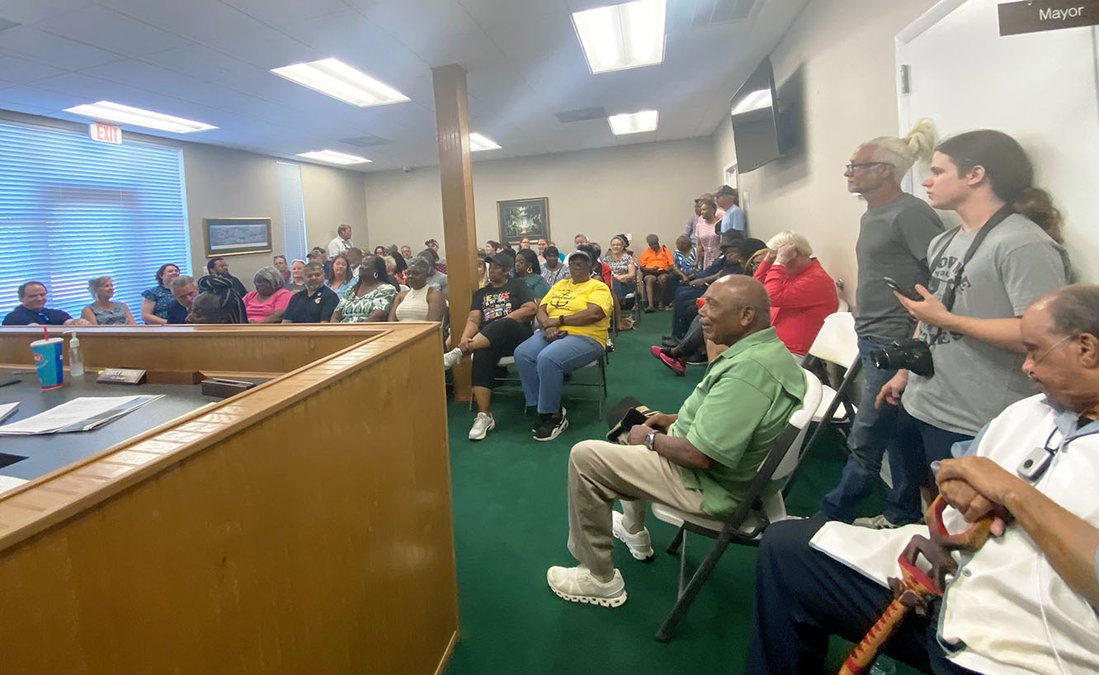
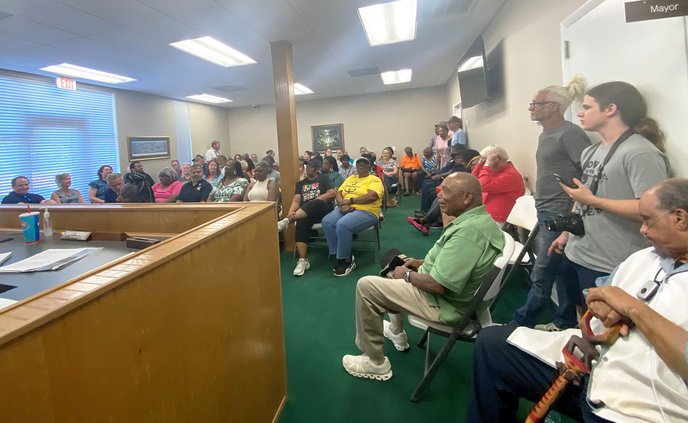
An overflow crowd is shown at Thursday's City of Glennville Ethics Committee inside City Hall. - photo by Pam Waters

More than 100 people attended the first-ever meeting of the City of Glennville Ethics Committee Thursday evening, with dozens also in the hallways of the City Hall meeting room that overflowed with irate citizens.

Their anger was rooted in a video of an April 28 council meeting in which Glennville Mayor Bernie Weaver and council members Marc Nobles, Greg Janeczek and Tammy Waters were shown on video conducting another meeting after a special called meeting, in possible violation of the Georgia Open Meetings Act.

During that second meeting, the four made degrading remarks about local businessman Zuber Malek, with one calling him a terrorist, and made negative remarks about city staff, the former city attorney, and the Chamber office staff, while using profanity, as well.

The Glennville City Ethics Committee, comprised of Dr. Paul Thompson, Quentin McArthur and Linda Gail Thomas, were accompanied by City Attorney Drew Johnson and City Clerk Delilah Bryant, a 28-year employee of the City of Glennville. City Council member Cynthia Miller also was present.

Thompson moderated for the Ethics Committee, commenting, "We understand the seriousness of the allegations and occurrences like this are so very divisive to our community.”

He further acknowledged that the Board of Ethics was established for review and recommendations on actions of the city officials and not the employees.

He quoted from a section of the Georgia Municipal Association (GMA) handbook, "Ethics in Government: Charting the Right Course.”

“The public rightfully expects its elected officials to conduct themselves with honesty and integrity while working for the common good, and a representative democracy demands such action if it is to function effectively. Trust is the key word to describe the appropriate relationship between elected officials and their constituents. An elected official obtains the privilege to serve only by earning the trust of a majority of the electorate, and the official must be careful not to compromise that trust in any way once he or she has been inducted into office.

PAM WATERS/staff Pictured Tuesday at the Glennville Ethics Committee meeting in City Hall are, left to right, Glennville City Attorney Drew Johnson, City Clerk Delilah Bryant, Ethics Committee members Quentin McArthur, Dr. Paul Thompson and Linda Gail Thomas. Glennville City Council member Cynthia Miller is seated at the table.
Pictured Tuesday at the Glennville Ethics Committee meeting in City Hall are, left to right, Glennville City Attorney Drew Johnson, City Clerk Delilah Bryant, Ethics Committee members Quentin McArthur, Dr. Paul Thompson and Linda Gail Thomas. Glennville City Council member Cynthia Miller is seated at the table. - photo by Pam Waters

The elected official must always bear in mind: "All government, of right, originates with the people, is founded upon their will only, and is instituted solely for the good of the whole. Public officers are the trustees and servants of the people and are at all times amenable (responsible) to them." (Taken from the Georgia Constitution Article I, Section III)

Thompson further pointed out that these laws emphasize the need for elected and appointed officials alike to show impartiality, efficiency, fairness and honesty in all of their dealings. Further, the GMA Ethics Task Force established five essential principles for effective, ethical government: (1) Serve others, not ourselves. (2) Use resources with efficiency and economy. (3) Treat all people fairly. (4) Use the power of our position for the well-being of our constituents. (5) Create an environment of honesty, openness, and integrity.

"We, the Ethics Board, now serve to determine if and at what levels these ethical principles were broken,” Thompson said to the crowd. “We do not, however, have the power to place any kind of disciplinary action on those involved. We can determine wrongdoing based on the ethics ordinance the city has adopted and make recommendations that would benefit the city moving forward, but the power then rests on the council and on you, the people.”

In essence, the Ethics Committee can determine if ethical principles were broken and if there was wrongdoing, but it can only make recommendations to the council to take action. However, that would entail the mayor and three council members in question agreeing to take action against themselves for their actions.

City Attorney Drew Johnson stated that this meeting was not an open meeting for discussion or for citizen input. He added he wasn't aware of any complaints until shortly before the meeting, and the one submitted by Zuber Malek had not been notarized and filed with the City Clerk under oath, which i a requirement.

Malek's attorney Greg Gilluly was at the meeting and encouraged those with complaints to come forward. After the filing of a complaint, the city clerk has seven days to forward the complaint to whom the complaint has been filed, and then a hearing can be held within 60 days if there is enough evidence to proceed with a hearing.

However, Attorney Johnson stated that the city clerk would stay after the meeting to take any complaints submitted and to notarize them that evening for the complaint to be officially filed. Complaints were encouraged to be submitted in the following days at City Hall.

Questions arose about the mayor and three council members, based on whatever recommendation is made, having the power to rule on a complaint against themselves, which, in essence, provides no recourse for the citizens in an action against these four city officials.

The Ethics Board's job is to make a recommendation to the council on action to be taken against the mayor and council members themselves, which is really a moot point for recourse.

"Our job is simply to make a recommendation to the council upon determining if a violation has occurred," said Thompson.

Extreme disappointment was voiced among those in attendance about having no effective way to discipline Weaver, Nobles, Janeczek and Waters for their conduct and possible violations of the public trust, or even a call for their resignation, since these four would be voting on themselves.

However, those who have been violated by their conduct can file a personal lawsuit against these four city officials.

Also, another recourse is to file a recall petition against the mayor and three council members.

The next scheduled City Council meeting is Tuesday, June 2.