A crowd of farmers; elected and appointed city, county, and state elected officials; and state candidates, along with U.S. Congressman Rick Allen gathered on August 24, 2026, in Lyons at the Toombs County Ag Center for the annual Legislative Dinner hosted by the Farm Bureau offices of Tattnall, Toombs, and Evans counties. Education in Tattnall County was represented by Tattnall County School Superintendent Dr. Kristen Waters and School Board Chair Mary Ruth Ray.
The event was opened at 7 p.m. by Chris Hopkins, Toombs County Farm Bureau President, who welcomed those attending, including Tattnall County Farm Bureau President Cliff Riner. A special guest is always Tom McCall, President of the Georgia Farm Bureau, and he was accompanied by his wife, Jane.
McCall encouraged rural people to please vote in the November election. Their vote is so vital when a large part of the population lives around the Atlanta area and most do not have the agricultural interests of those who live in the rural part of the state, he pointed out. Agricultural is the largest industry in the state of Georgia, he emphasized.
State Senator Blake Tillery extended his thanks for the voters placing him in the General Assembly the past ten years. He commented the late Senator Jack Hill was a tremendous influence on the state and agriculture, and between the two of them, they had held the top appropriations seat for 23 years. He, too, urged citizens in South Georgia to vote in November, especially with 60 percent of the populatio is living north of I-20.
He welcomed candidates Brad Anderson, State House Republican candidate, and David Sikes, State Senate Republican candidate, who were in the audience.
State Representative Leesa Hagan, who represents the counties of Toombs, Montgomery, Wheeler, Telfair, and Ben Hill, and part of Tattnall County, complimented the Farm Bureau and their influence and thoughtfulness on legislation considered in the state.
“In our part of the state, agriculture is not just an industry, it’s part of our identity,” she said, and Hagan has served on the State Ag Committee the past five years.
She referred to several ag-related bills passed this past session, which included House Bill (HB) 946 and HB 983.
HB 946 refers to the feral hog problem, which "provides for the trapping of feral hogs without a license or trapping license, provided that such hogs shall be killed upon capture," along with the use of drones for locating the feral hogs. The feral hog population has been an enemy of farmers for years.
HB 983 further defines the Forestry Commission's definition of prescribed burning so as to mitigate catastrophic wildfires. This specifically refers to "burning for site preparation of land for timber cultivation, hazard fuel reduction, understory control, wildlife habitat improvement, natural regeneration, longleaf pine ecosystem maintenance, and timber stand improvements."
Hagan also commented on CUVA (Conservation Use Valuation Assessment), which prescribes for certain properties, including agricultural lands and forestlands, to be eligible for reduced property tax rates through CUVA. She related that a constitutional amendment will be on the November 3 ballot to increase this acreage from 2000 acres to 4000 acres.
Reggie Cofer, representing U.S. Senator John Ossoff, commented that the Senator is "sensitive to the strains on you as farmers and that disaster relief needs everyone working together for solutions."
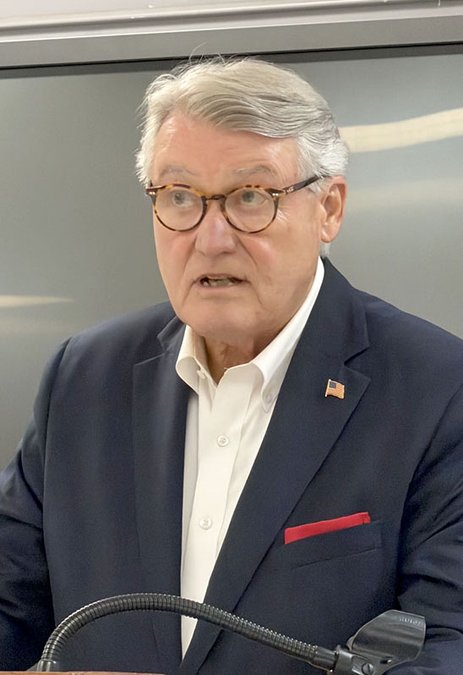
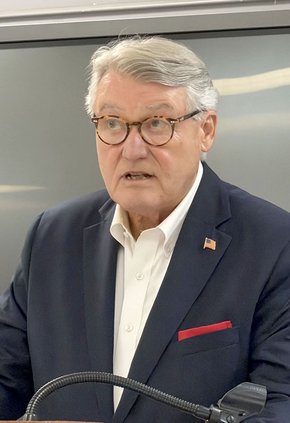
Congressman Rick Allen, who grew up on his family's farm, recognized the struggle of Georgia farmers and the high input cost and high interest rates as well, with inflation taking its toll, too.
He commented that the Farm Bill has to be re-authorized every five years, and it is on its third year for an extension, which expires September 30.