By allowing ads to appear on this site, you support the local businesses who, in turn, support great journalism.
The Reidsville TOS Theatre
TOS 1 copy.jpg

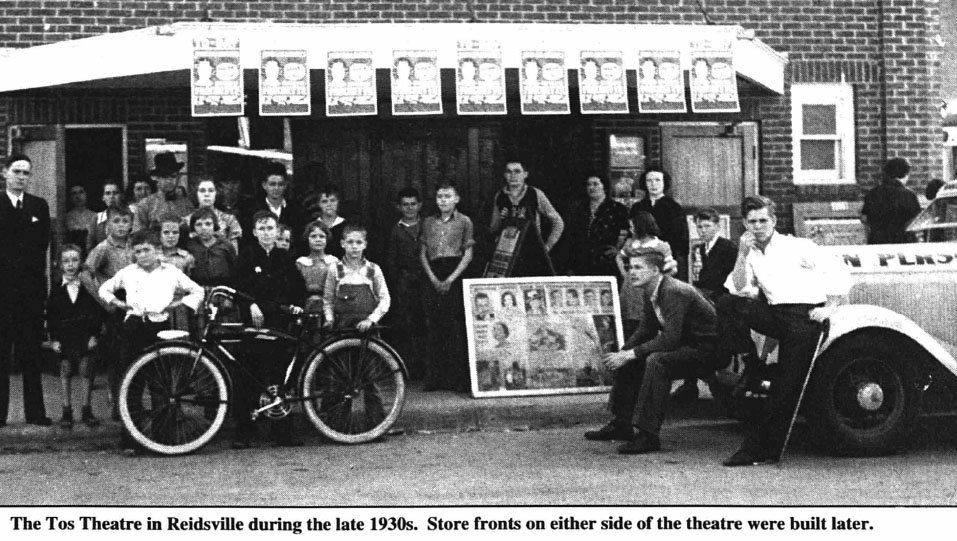
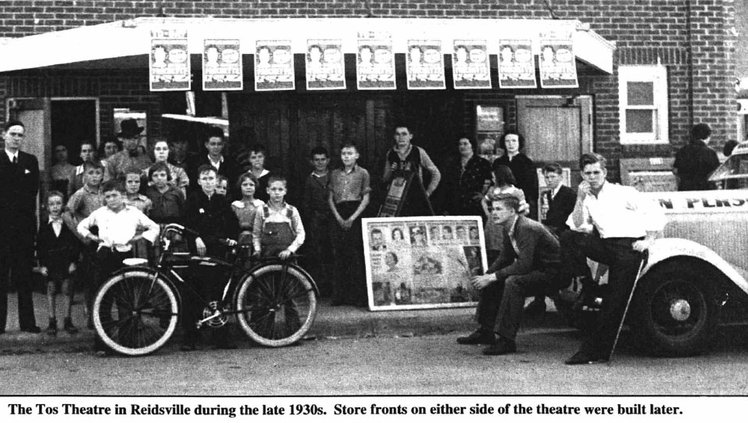
The Reidsville TOS Theater, which opened on June 1, 1937, served the Reidsville community for nearly four decades. The founder of the TOS, Savina B. Tos, was an Italian immigrant who arrived in New York in 1902. His economic ventures brought him to Claxton, Georgia, and he would develop a chain of five TOS theaters, including Pembroke, Reidsville, Collins, and Claxton where a TOS Drive-In was located along with a regular theater.

In designing the Reidsville TOS, Mr. Tos said it would be the most modern and up-to-date theater in the state. It was located between the D.T. Phillips Department Store and what would become Thain’s Five and Ten Cent store on the west side of Main Street. The capacity was 320 seats downstairs and 105 in the balcony. It was one of the first buildings, along with Summerford’s Drug Store directly across the street, to have air conditioning in the 1950s. From the opening date until the early 1960s, ticket prices were 25 cents for adults, 10 cents for children under 12, and 15 cents for senior citizens. A youngster under 12 could enjoy an evening of entertainment for 25 cents. That would include 10 cents for the ticket to “the show,” a dime for a bag of popcorn, and a nickel for a Coke.

TOS 2 copy.jpg

The late Byron Lynn of Lynntown worked as a projectionist prior to becoming a tail gunner on B-17 Bombers in Europe during World War II. He earned $30 to $40 a week, which was a good salary in those days. After the war, he returned and worked at the same job for a while. The war was over, but effects of the Great Depression lingered. Getting and keeping a steady job was a high priority.

Bill Jordan would become the projectionist in the 1950s and ‘60s. Ms. Nat Moore sold and took up tickets during those days and seemed to know the age and birthday of every child in Reidsville. The price for a ticket went from a dime to a quarter when the viewer turned 12 years old. Also, if the audience got too noisy, the flashlight would come on, and there would be a “shhhhhhh” warning. Viewers were not allowed to disturb other viewers.

The TOS provided much needed entertainment for locals during the midst of the Great Depression, World War II, and the Korean Conflict. Although the most obvious purpose was entertainment, newsreels ran on weekends between movies to update Americans concerning the latest news during WW II and Korea. As might be expected, American and Allied successes were emphasized, but less successful efforts were also shown, although there was always a positive spin even when the good guys came up a little short. In the pre-television days, the-low-budget B movies with stars like Gene Autry, Roy Rogers, Johnny Mack Brown, and Lash LaRue provided youngsters with fast action entertainment along with a strong dose of Boy Scout virtues. All of the cowboy themes were similar if not the same. A lone hero in a white hat (except for Lash LaRue) would ride into a town controlled by a group of gangsters in black hats and mustaches who were robbing the stage coaches or trains. Included in the cast would be at least one beautiful blonde, brunette, or redhead who was always in the action and usually had to be rescued by the leading man right at the end. Invariably, there would be a shootout in a box canyon or on a cliff where the hero was surrounded by the black hat gang. Fortunately, he always had a 44-caliber Colt six shooter (or two) on his hip that would shoot up to 40 times before reloading was necessary. Occasionally though, he would shoot it empty and have to frantically reload as the black hat thugs closed in. The melodramatic music would get loud, and one’s heartbeat would rev-up like a hot rod Ford engine at a 1960s drag strip. It would be obvious that the hero was just before checking out for the promise land. At the last possible moment, the horse cavalry would dash in with guns a-blazing and save the day.

The shootouts most often took place on foothills or in canyons with huge boulders all around. The hero would be fighting off the black hats, and one would always try to slip around behind Gene or Roy or Johnny Mack and bushwhack them from the rear. In the pre-integration days, black patrons sat in the balcony. Once, Gene Autry was facing off about a dozen bad guys, and one was easing into position for a bushwhacking shot from the rear. A kid in the balcony yelled, “Look Out, Gene! He’s behind you!”

In the midst of the uproarious laughter, Gene turned quickly and dispatched the miserable varmint. No doubt, that young man saved Gene’s life.

When I went to ‘the show’ with my mother and sister, they always made me sit close to the rear of the auditorium. I always wanted to sit on the front row and finally got the opportunity once at about seven years old when I went by myself. It was a cowboy movie with an exciting chase scene involving a bunch of masked bandits and a locomotive running like it was trying to win the Daytona 500. The movie director had come up with the bright Idea of embedding a camera in the middle of the railroad track to record the approaching train. Unfortunately, I was sitting in the front row with a full bag of popcorn and a Coke. That doggoned runaway locomotive ran right over me. I escaped with no broken bones, but my popcorn and Coke ended up on the floor, and I didn’t have another 15 cents.

TOS 3 copy.jpg

The acting was not great, but we loved it. Still, the best fist-fight I ever witnessed took place two doors down at the front door of the Sims Grocery Store a little after sundown one warm summer evening. While his mother was paying the grocery bill at the checkout register, a six-or-seven-year-old boy had, undoubtedly, been to ‘the show’ and witnessed one of those fights when the hero was beaten severely before miraculously recovering and knocking out all the guys in the black hats. The kid was surrounded by at least a half-a-dozen imaginary outlaws, and they knocked him down more than once. He made a clicking sound with his tongue that imitated the Hollywood generated sound of a fist hitting one’s jaw, and he did it when he hit them, and they hit him, and with one’s eyes closed, it sounded like a Gene Autry or Roy Rogers fist fight. Finally, the determined youngster prevailed. I think he was taking them to jail when I left. That was the effect ‘the show’ could have on young cowboys.

In reality, such entertainment had, generally speaking, a positive influence; the good guys always treated women with respect and always won in the end. They were well mannered and protected those who were most vulnerable. In short, they portrayed positive aspects of the human species, such as honesty, humility, and treating others as we would like to be treated, etc.

When television burst on to the scene in the early 1950s, the mass entertainment industry continued the theme of the old West cowboy movies. Short, 30-minute adventures like Wagon Train, Maverick, Wyatt Earp, Daniel Boone, and Have Gun, Will Travel filled the entertainment space at home, whereas Roy and Gene and the big screen heroes had drawn millions to the movie theaters. Still, big names like John Wayne, Steve McQueen, Clint Eastwood, etc., continued to entertain audiences on the big screen. The old West theme was still popular, and, as Mrs. June Smith said recently, “it was the best popcorn in the world.”

Big name actors with higher budget productions required bigger and multiple screens, more comfortable seats, and more choices at the concessions. Small town movie theaters with single screen facilities like the TOS became less popular as audiences demanded more variety and parking was limited. Larger multi-screen facilities attracted the younger generations as they migrated to larger urban centers, and it became harder for small independent single screen operators to secure new films during opening weeks. As profits dwindled, small independent theaters in rural towns began to close their doors. The TOS Theater closed as a movie theater in 1975.

In the spring of 2001, local entertainer Mark Cartwright reopened the TOS as the Ohoopee River Opry House and replaced the big screen with live entertainment. Initially, the response was positive, but once again, parking would be a problem and, no doubt, limited the size of audiences. Consequently, the efforts to return to the glory days of the 1940s and ‘50s did not materialize. Demolition of the building began in late August, 2026.

References

The TOS Theater of Reidsville. James Kicklighter, The Tattnall County Heritage Book, p. 20

Tos Theatre gets new life. Allison Cobb. The Tattnall Journal, March 22, 2001